When breast surgery leaves the areola scarred, faded, stretched or uneven, our areola enhancement tattooing restores even color, blends the appearance of scarring, and corrects shape, size and symmetry over your natural or reconstructed nipple.
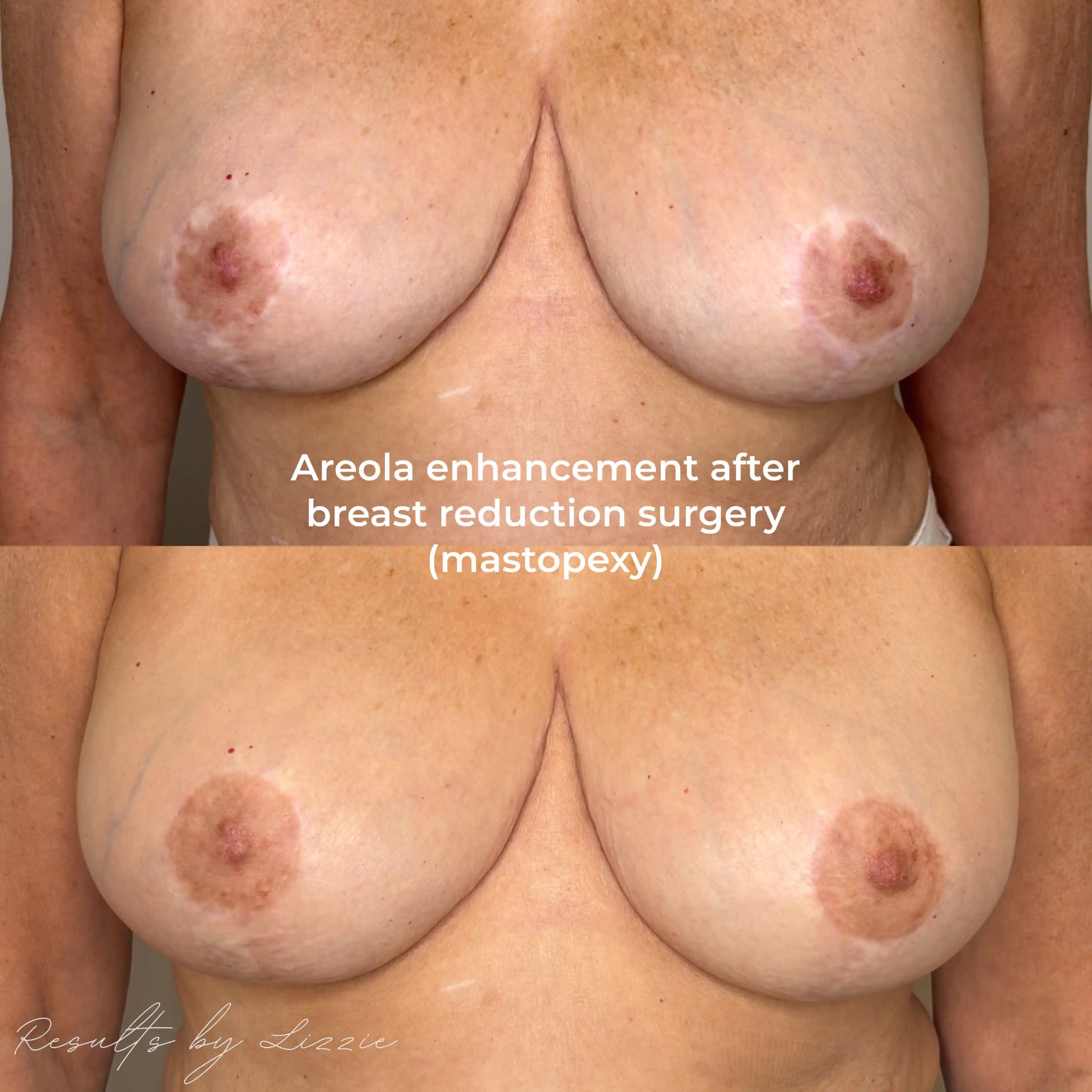
Our areola restoration and enhancement tattooing improves the appearance of the nipple and areola after being affected by breast surgery. After breast augmentation, reduction, a lift or other surgery, the areola can be left scarred, faded, stretched, uneven in shape or size, or mismatched side to side. Your artist tattoos pigment into the areola to even out the color, blend the appearance of scarring, and correct the shape, size and symmetry, matched to your skin tone and your anatomy.
This is an enhancement for an existing nipple/areola complex. If you have had a mastectomy and need a nipple and areola recreated, see Post-Mastectomy 3D Nipple and Areola Tattooing.
Scarring and scar tissue are not prohibitive. We ask that surgical scars be fully healed, usually 6 months after surgery, or sooner with your doctor's written approval.
As the skin heals, the pigment stays, and the corrected color and shape are yours every day.
Please read our before you arrive instructions so you come in ready. Our areola tattoo aftercare instructions explain how to care for the area and what to expect each day of healing.

Natural results don't happen by accident. They come from skill and technique, refined over thousands of clients. Six things we do at every appointment make the difference:
Pigment is placed in the upper layer of the skin: deep enough to last, shallow enough to heal soft. Skin around surgical scars can be thinner or uneven, so depth matters even more. At the proper depth the color lasts without oversaturating, and it softens evenly over the years instead of spreading or changing color.
Your artist starts from your existing areola: where the border should sit, how large it should be, and how to bring both sides into symmetry. The design is drawn on and shown to you in the mirror. Nothing starts until you approve it.
Pigment is mixed to match your existing areola, your skin tone and your undertone, so corrected borders and blended scars disappear into the whole instead of standing out. We keep close track of your formulation, so any touch-up or refresh matches, even years later.
Your artist works at a high machine speed with a whip technique, which layers pigment softly in fewer passes. Less trauma to delicate or scarred skin means minimal scabbing and itching while you heal, and a softer result.
We take a conservative approach in session one and finish at your touch-up 6 to 12 weeks later, if it is needed. That ensures every area healed consistently and gives you the opportunity to adjust color or definition. The touch-up is included in the price.
We use only pigments and needle cartridges manufactured in the USA, and we have refined what we use over thousands of appointments to the products that deliver the most natural, longest-lasting healed results. Every cartridge is single-use and disposable, discarded after your appointment.
Kendra and Lizzie perform all nipple and areola tattooing at KNS. Each has thousands of hours of tattooing experience, with exceptional skill in shading, design, symmetry and technique.
More than 8,000 clients have had permanent makeup at KNS, from all 50 states. Our artists have 25+ years of combined experience and do permanent makeup full time. As a team, we are constantly improving our craft: every week we review client cases together to develop best practices, study where to improve, and hold ourselves accountable to the natural, healthy healed results we promise.
No. 3D nipple and areola tattooing recreates a nipple and areola that were removed in a mastectomy. Areola restoration and enhancement improves a nipple and areola that are still there: scars, color, shape and symmetry. If you have had a mastectomy, see Post-Mastectomy 3D Nipple and Areola Tattooing.
It blends them. Pigment matched to your areola and skin tone makes a scar far less noticeable, but tattooing does not remove the scar itself, and raised or very new scars respond less. We give you an honest expectation at your consultation.
Scars should be fully healed, usually 6 months after surgery, or sooner with your doctor's written approval.
Most clients report little pain. Skin around surgical scars often has reduced sensation, and we also use a topical numbing cream.
The tattoo is permanent. Like all tattoos it softens over years, and a refresh every few years keeps the color and definition.
Due to privacy concerns, guests are not allowed in the procedure area. If you bring a guest, they will need to remain in the waiting area.
Ready to book?


